

Recently, Professor Chen Haifeng's research group, the company's founder, published their research findings entitled "Excited-Ground State Transition of RNA Strand Slippage Mechanism Captured by Base-specific Force Field" online in *J. Chem. Theory Comput.*. This study provides important references for the development of personalized and precise RNA molecular force fields and the mechanism of dynamic RNA conformational transitions. Li Zhengxin, a doctoral student, and Song Ge and Zhu Junjie, undergraduate students from the School of Life Sciences and Biotechnology at Shanghai Jiao Tong University, are co-first authors of the article. Professor Chen Haifeng of the School of Life Sciences and Biotechnology is the corresponding author, and the Department of Bioinformatics and Biostatistics of the School of Life Sciences and Biotechnology at Shanghai Jiao Tong University is the first corresponding affiliation.
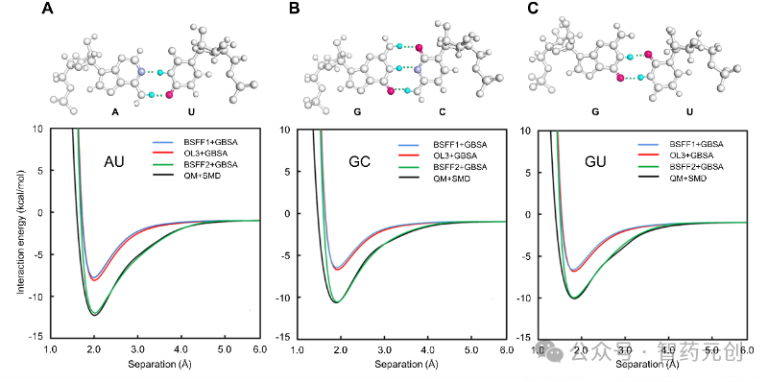
Figure 1. Energy scans and corrections for AU, GC Watson-Crick pairings and GU non-Watson-Crick pairings.
The RNA dynamic conformation ensemble is fundamental to its diverse physiological functions, including transcription, translation, and catalysis. Current experimental methods struggle to accurately resolve these conformations, making molecular dynamics simulations a crucial research tool. The molecular force field determines the accuracy of molecular dynamics simulations; however, existing RNA molecular force fields have several shortcomings. Previously, Chen Haifeng's research group developed several improved RNA molecular force fields. This study proposes BSFF2, which further optimizes the main chain structure and introduces secondary structure pairing energy correction terms based on the previous BSFF1 study (Figure 1), thereby capturing RNA dynamic conformation information more accurately.
Validated results show that the BSFF2 force field can accurately simulate various common RNA motif systems, such as tetranucleotides, short single strands, double strands, and protrusions. It also demonstrates extremely high efficiency in simulating tetraloop de novo folding, base pairing recombination, and chain sliding. It can capture the molecular details and mechanisms of chain sliding of r(G4C2) repeat elements (Figure 2), providing an effective research tool for elucidating closely related neurodegenerative diseases such as ALS. It has important research value for the development of targeted RNA drugs and RNA therapies.
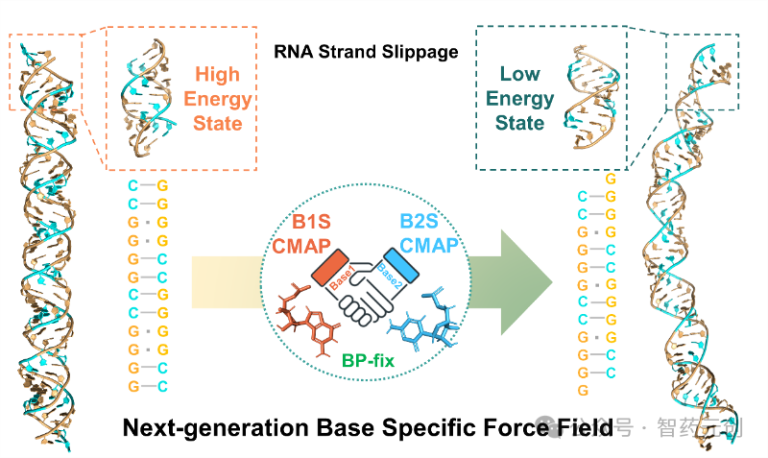
Figure 2. BSFF2 force field simulation of chain slippage trapping the repetitive element r(G4C2).
This research was supported by the Supercomputing Center of Shanghai Jiao Tong University, the National Natural Science Foundation of China (21977068 and 32171242), the National Key Research and Development Program of China (2023YFF1205102 and 2020YFA0907700), the Fundamental Research Funds for the Central Universities (YG2023LC03), and the Open Testing Fund for Valuable Instruments and Equipment of Fuzhou University (2024T022).
Paper link:https://pubs.acs.org/doi/10.1021/acs.jctc.4c00497



 WeChat Customer Service